
Financial services IT support in Brisbane
Protect financial data and meet strict regulatory requirements with IT built for financial institutions and advisors.
- Client file access
- Email fraud filtering
- Multi-factor sign-in
- Immutable backups
- Essential Eight review
Defy IT provides managed IT support and cyber security for financial advisers, planners, mortgage brokers and similar practices in Brisbane and South East Queensland. We protect client financial files, secure email against payment fraud and build security around the Essential Eight, so you can show clients and regulators that you take their data seriously. It suits small and mid-sized practices without an internal IT person.
Built for the most targeted data there is.
A standard setup can’t deliver the transaction security and compliance you need.
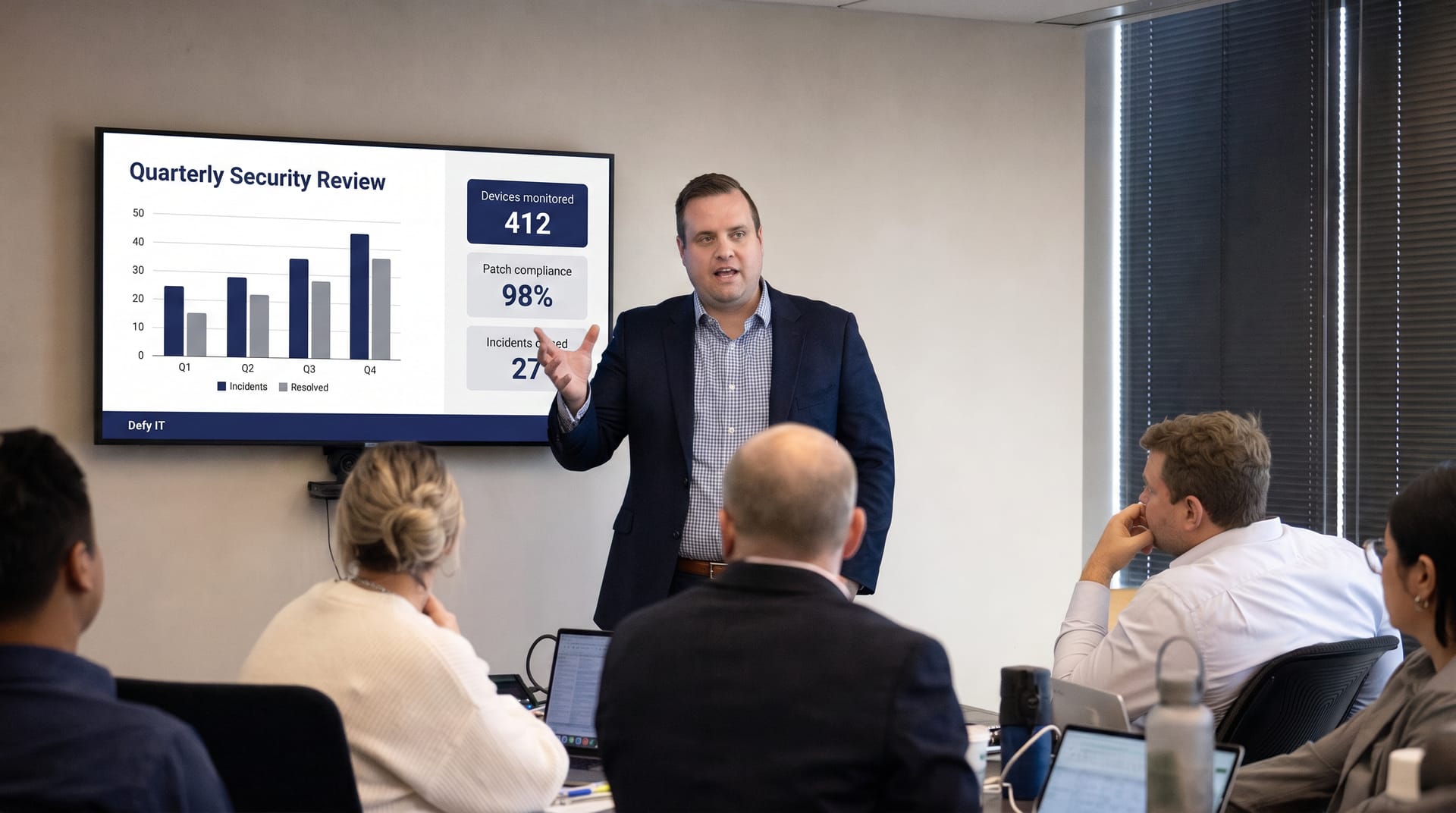
Protecting your clients’ wealth starts with their data.
Managed IT support
Proactive monitoring and fast response for financial software and systems.
Cyber security & Essential Eight
Application control, patching and multi-factor authentication.
Microsoft 365 & cloud
Cloud environments configured for financial data.
Backup & recovery
Immutable backups so financial records survive ransomware.
Network & server support
Infrastructure that keeps your firm running securely.
Secure transaction systems
Encrypted networks and portals for financial operations.
Finance is the top target. We build like it.
The challenges every financial firm faces — and how we handle them.
Book a free IT review- 01Systems locked, ransom demanded — the norm we reject.Immutable backups, so financial records come back without paying.
- 02Emails that authorise fraudulent payments — the norm we reject.Defences against business email compromise and phishing.
- 03Client documents on personal drives — the norm we reject.Every file gets a clear home, controlled access and a retention rule.
- 04One login that opens everything — the norm we reject.Access controls set per financial team.
- 05Compliance you can’t evidence — the norm we reject.Controls you can show an auditor.
- 06A standard office IT setup — the norm we reject.IT built for ASIC, APRA and Privacy Act obligations.

Client files that stay where they should
Payslips, bank statements, identity documents — each needs a clear home, controlled access and a retention rule.
We set up storage, email security and device controls so that material never lands on a personal drive or unencrypted laptop — and you can prove it to an auditor.
Technology that supports your obligations.
Technology supports compliance. It does not determine it. Your firm and its advisers decide what the obligations require.
Essential Eight
The ASD baseline of mitigation strategies against cyber threats.
Privacy Act 1988
Adherence to the APPs for client financial information.
NDB Scheme
Logging and alerting that can help identify a possible eligible data breach.
Transaction security
Technical controls that protect transaction integrity.
“Great to deal with always gets the job done”
Why financial practices are a target
Financial advice and broking practices hold payslips, bank statements, identity documents, tax file numbers and detailed pictures of clients' wealth. Criminals can use that information to commit identity fraud, and they can use a hijacked email account to redirect money. The most common route is not a sophisticated hack. It is a stolen email password, a fake email that appears to come from a client asking for funds to be moved, or client documents sitting on a personal drive or unencrypted laptop.
A second problem is evidence. Clients, licensees and auditors increasingly ask how client data is protected. "We think it is fine" is a weak answer. Being able to show where files live, who can open them and how they are backed up is a strong one.
Your obligations, in plain English
The Privacy Act 1988 and the Notifiable Data Breaches scheme may apply, depending on the practice. If personal information is accessed or disclosed in a way likely to cause serious harm, the practice may need to notify the OAIC and the people affected. Whether it applies to your practice, and whether an incident is notifiable, is for you and your advisers to decide.
If you hold an Australian financial services licence or are authorised under one, ASIC has set out expectations about cyber resilience for licensees, including publishing good practice guidance. Licensees generally need adequate risk management and systems, and cyber risk is part of that. Check with your licensee or compliance adviser about what is expected of your practice.
APRA's prudential standard CPS 234 on information security applies to APRA-regulated entities, such as banks, insurers and many superannuation trustees, and in some cases to the third parties that service them. Most small advice practices and broking businesses are not APRA-regulated, so CPS 234 will not apply directly. If your practice services an APRA-regulated entity, the contract with that entity may pass related requirements down to you, and you should read it carefully.
Technology supports compliance, it does not determine it, and no IT provider can guarantee compliance. This page is not legal or compliance advice.
Software financial practices commonly use
Advice practices commonly use platforms such as Xplan (from Iress), Midwinter and Class, along with investment and superannuation platforms such as Netwealth, plus Microsoft 365 for email and files. Mortgage brokers commonly use aggregator and CRM systems supplied through their aggregator. We look after the devices, network, access, backups and security around your systems and work with the software vendor on application issues. The agreement states which products are covered and who owns each part.
The Essential Eight, applied to a financial practice
The Essential Eight, from the Australian Signals Directorate, is a baseline of mitigation strategies. In a financial practice, the first priorities are usually:
- Multi-factor authentication on email, advice and CRM platforms and remote access.
- Patching, so known weaknesses in operating systems and applications are closed.
- Regular, tested backups that ransomware cannot alter, so client files can be restored without paying.
- Restricting administrator access, so a single compromised account cannot reach every client.
- Application control and macro settings, which help block malicious attachments.
It is a framework to work towards in stages, not a certificate.
What good IT looks like for a financial practice
Every client document has a clear home, controlled access and a retention rule. Nothing lives on a personal drive or an unencrypted laptop. Access is set per team or per adviser, not one login that opens everything. Email filtering, multi-factor authentication and a verification step for payment instructions reduce the chance of fraudulent transfers. You can show a licensee, auditor or client what controls are in place and how they are checked. Our blog posts on payment redirection scams and Microsoft 365 security cover the practical details.
How we work with financial practices
- 01
Free IT review. We start by talking through your practice, your client data and your concerns.
- 02
Document what exists. We audit devices, servers, Microsoft 365, the network, backups and security, and write it down.
- 03
Fix the biggest risks first. We deal with the most serious gaps first and agree the order with you.
- 04
Ongoing monitoring and support. We monitor agreed systems and support your team remotely, and attend your office when needed.
- 05
Plain-English communication. We explain what we found and recommend, and confirm scope, cost and next step before any work begins.
- 06
No lock-in. There are no lock-in contracts.
Technology supports compliance. It does not determine it, and this page is not legal or compliance advice. Your practice, licensee and advisers decide what your obligations require.

Secure your financial firm today
Don't wait for an incident to find the gaps. Book a comprehensive IT review tailored for Australian financial professionals.
Local support across South East Queensland