
Essential 8 Compliance Guide for Australian Businesses
Master Essential 8 compliance for Australian businesses. Learn the 8 controls, maturity levels, implementation roadmap, and industry-specific requirements.
 Brandon Strangman8 min read
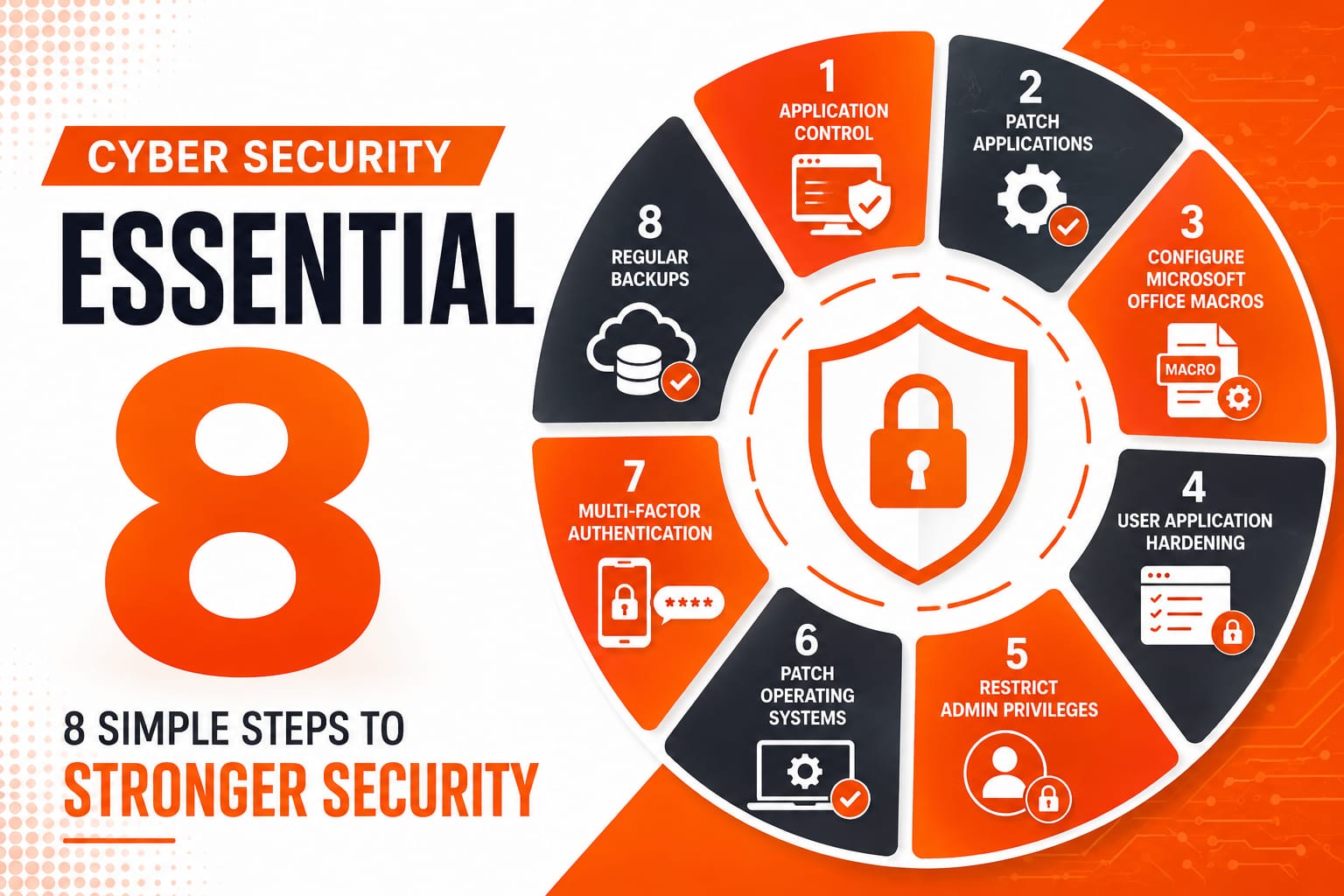
Essential 8 Compliance Guide
The Australian Signals Directorate (ASD) Essential 8 is the Australian Government's baseline set of cyber security mitigation strategies. It is mandatory for some Australian Government entities, and clients, tenders, regulators and cyber insurers may ask about it.
What Is Essential 8?
Essential 8 is a set of eight mitigation strategies addressing the most common cyber attack vectors. The ASD describes them as a baseline that makes systems much harder to compromise, not a guarantee against every attack.
The Eight Controls
1. Application Whitelisting
Only approved applications can run on your systems. This prevents malware and ransomware from executing.
2. Patch Management
Regularly update all software, operating systems, and firmware. Patch critical vulnerabilities within 48 hours.
3. Multi-Factor Authentication (MFA)
Require two or more verification methods to access systems. MFA blocks the large majority of automated account-takeover attempts.
4. Restricting Administrative Privileges
Limit who has administrative access. Administrative accounts are high-value targets for attackers.
5. User Application Hardening
Configure applications to be more resistant to attacks by disabling unnecessary features.
6. Regular Backups
Maintain regular, tested backups of critical data stored separately from production systems.
7. Disable Unnecessary Ports and Services
Turn off network ports and services that aren't needed for business operations.
8. Logging and Monitoring
Collect and analyze security logs to detect and respond to attacks.
Maturity Levels
Level 1 (Basic): Implements fundamental controls. Aimed at widely available, opportunistic attacks.
Level 2 (Intermediate): Implements more comprehensive controls. Aimed at attackers willing to invest more time and tooling in a target.
Level 3 (Advanced): Implements advanced controls with automation. Prevents advanced persistent threats.
Most Australian businesses should target Level 2 as a minimum.
Industry-Specific Requirements
Healthcare: Our Medical IT services ensure healthcare organizations meet Essential 8 requirements.
Financial Services: Banks must implement Essential 8 to comply with APRA requirements.
Legal Firms: Our Legal IT services help firms implement Essential 8.
Accounting Firms: Our Accounting IT services help support compliance obligations.
Implementation Roadmap
Phase 1: Assessment
Conduct a gap analysis, identify current maturity level, document findings, and prioritize controls.
Phase 2: Planning
Develop implementation roadmap, allocate budget and resources, establish timelines.
Phase 3: Implementation
Deploy security technologies, configure systems, implement policies, conduct staff training.
Phase 4: Validation
Conduct security testing, verify control effectiveness, document compliance evidence, establish ongoing monitoring.
Common Challenges
Cost and Resources: Prioritize controls by risk and implement in phases.
Legacy Systems: Assess for compatibility. Plan for upgrades or replacements as needed.
Staff Resistance: Invest in training and change management.
Maintaining Compliance: Establish ongoing monitoring and regular reviews.
Essential 8 Compliance for Australian Businesses
Our Cyber Security services help Australian organisations work towards the Essential Eight baseline. Technology supports compliance but does not determine it; the right target depends on your obligations and risks.
Getting Started
Don't delay Essential 8 implementation. Start with a comprehensive assessment. Key first steps: conduct a gap analysis, understand your current maturity level, develop an implementation roadmap, allocate resources, and begin with high-priority controls.
Protect Your Business with Essential 8
The Essential Eight is a practical baseline for Australian businesses. Whether you are pursuing government contracts, responding to a client or insurer, or protecting your business from cyber attacks, it provides a useful framework. It is not a certification or a guarantee of security. For the official detail, see the ASD/ACSC Essential Eight guidance.
Written byBrandon StrangmanNeed Help with Your Business IT?
Ready to implement these strategies? Our expert team at Defy IT can help you build a resilient, secure IT environment tailored to your specific business needs.
Contact Us TodayReading up on cybersecurity? Explore our Cyber Security services or see how we help financial services businesses and accounting firms.